
What Is OpenStack?
An introduction to OpenStack, the Open Infrastructure Foundation, core cloud services, and use cases from the original article.
Published
- cloud computing
Archive article, first published 2023-11-15. The original context and examples are retained for review.
What Is OpenStack?
OpenStack is an open-source cloud platform and part of the broader cloud infrastructure ecosystem. The original article describes support from the Open Infrastructure Foundation, an organization that promotes and develops open-source cloud infrastructure projects. It explores the foundation’s role in OpenStack’s development. Open Infrastructure Foundation
What Is the Open Infrastructure Foundation?
Previously known as the OpenStack Foundation, the Open Infrastructure Foundation was established to support OpenStack and other open-source projects related to cloud infrastructure. It is a nonprofit organization that promotes and protects open source in cloud infrastructure management, with a large, diverse community at its center.
Its Role in OpenStack Development
The original article identifies three main roles:
- Supporting OpenStack development: Bringing experts and developers from around the world together to work on OpenStack.
- Building and supporting the community: Organizing conferences and events where community members share knowledge and experience.
- Collaborating with other open-source projects: Encouraging cooperation with related projects.
OpenStack Under the Open Infrastructure Foundation
The foundation’s support helps sustain OpenStack development and its community. The original article connects this support to opportunities for flexible cloud deployments, scaling, and integration with other technologies.
Core OpenStack Components
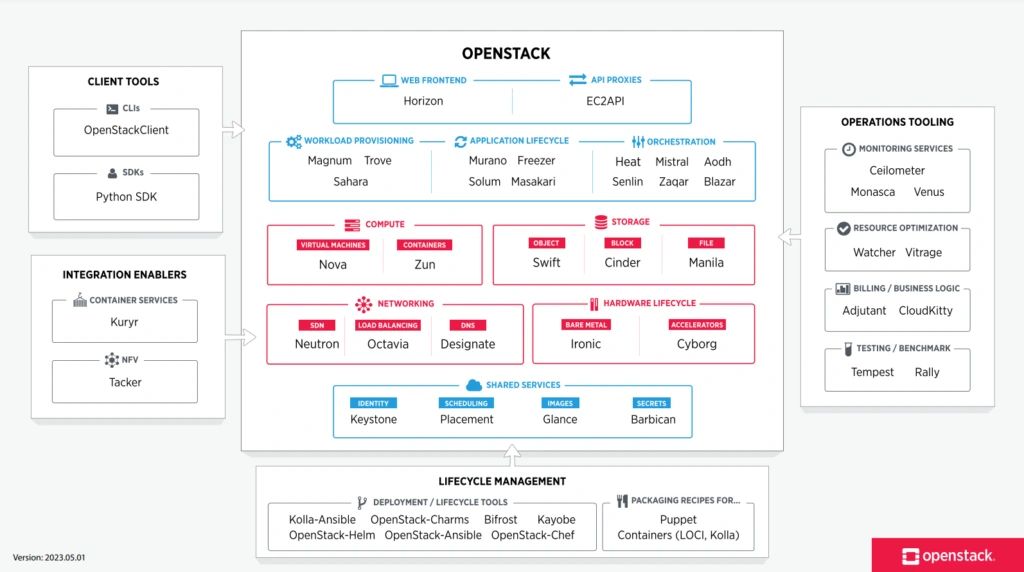
OpenStack landscape illustration preserved from the original Zotect article.
OpenStack brings together modules that manage cloud resources:
- Nova — Compute Service: Manages virtual instances.
- Swift — Object Storage Service: Stores unstructured data and supports large data collections.
- Cinder — Block Storage Service: Provides block storage for workloads with structured storage requirements.
- Neutron — Networking Service: Creates and manages private networks within OpenStack.
- Glance — Image Service: Stores and provides access to images used by virtual instances.
- Horizon — Dashboard: Provides a web interface for managing and accessing OpenStack resources.
OpenStack Use Cases
OpenStack supports customization and expansion for different requirements. The original article lists:
- Private cloud: Building and managing cloud infrastructure within an organization.
- Public cloud: Working with cloud providers to expand available resources.
- Cloud-native applications: Developing applications designed for cloud environments.
Why OpenStack Matters
- Flexibility and customization: Extensive customization options suit organizations with specific requirements.
- Open-source community: Users and developers support the platform’s continuing development.
- Technology integration: OpenStack can work with other technologies and platforms.
Organizations Mentioned in the Original Article
The original article cites the following examples of OpenStack adoption:
- CERN — European Organization for Nuclear Research: Uses OpenStack to manage large volumes of physics research data, with thousands of virtual machines.
- AT&T: Uses OpenStack for cloud and network services, helping it manage growing data volumes.
- Walmart: Has used OpenStack to support large retail operations and improve its online shopping experience through cloud technology.
- China Mobile: Has used OpenStack to support large-scale network services and a range of customer offerings.