
What Is Kubernetes?
Kubernetes is the open-source system Google built to run, distribute, and recover application containers automatically.
Published
- cloud computing
- kubernetes
Run more than a couple of containers and you hit the same questions every time: who restarts the container that crashed at 3 a.m., who adds capacity when traffic spikes, and who keeps everything landing on a machine with room to spare. Kubernetes exists to answer those questions automatically.
What Kubernetes Is
Kubernetes (often shortened to K8s) is an open-source system for running, distributing, and recovering containers at scale. Google built it from years of running large-scale systems internally. Today it’s an open-source project with one of the widest communities and ecosystems in the industry, running on public cloud and on-premises hardware alike.
The name comes from Greek for “helmsman” — the person who steers a ship. That’s exactly the role it plays: keeping hundreds of containers moving in the direction you intended.
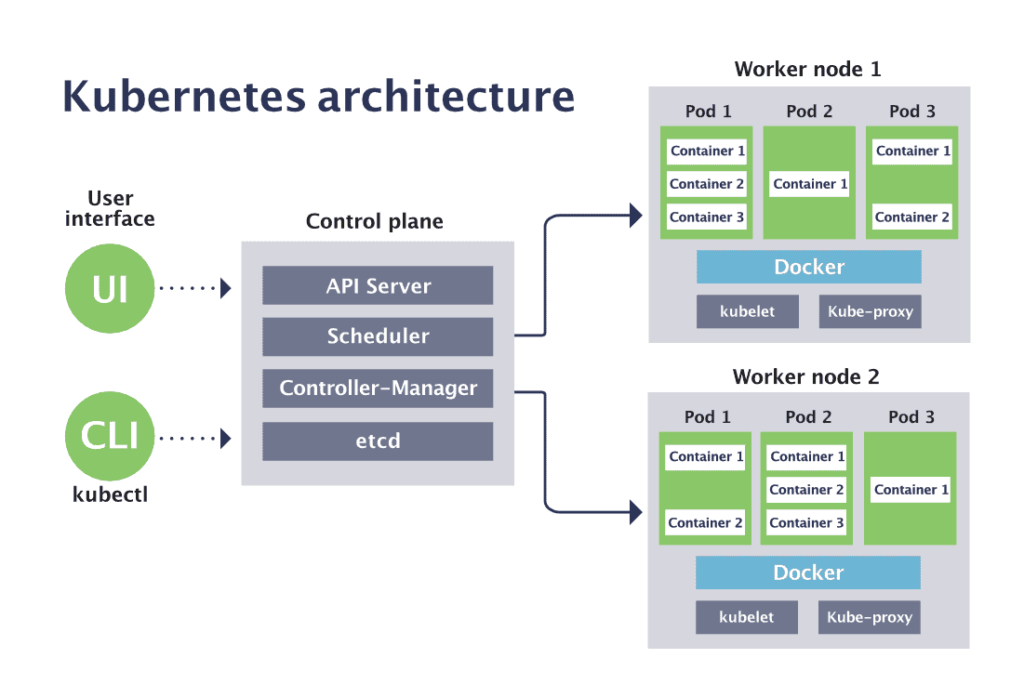
The key distinction: Kubernetes doesn’t run your application for you. It makes sure the containers holding your application stay running, stay reachable, and have the resources they need — continuously, against the spec you declared.
Why It Matters
Once your container count grows, manual management becomes a real burden:
- A container crashes — who restarts it? At night, on a holiday, with nobody watching.
- Traffic spikes — how do you scale? Spinning up machines one at a time can’t keep up.
- Some machines are packed, others are idle — resources go unused while you keep paying for them.
- How do you ship a new version without hurting users? Taking the whole system down to update it is a real risk.
Kubernetes handles all of this from a single set of configuration files. You declare what the system should look like — which container image, how many replicas, how much CPU and memory — and Kubernetes keeps reality matching that declaration. When something drifts, it corrects it.
The result is a system that heals itself when something breaks, uses resources more efficiently, and frees your team to build instead of babysitting servers.
Core Capabilities You’ll Use Daily
Self-healing — if a container crashes, Kubernetes restarts it. If an entire node goes down, the containers that were running there get rescheduled onto a healthy one.
Auto-scaling — add or remove containers based on real load, absorbing traffic swings without keeping spare capacity idle around the clock.
Deployment and rolling updates — ship a new version and Kubernetes rolls it out gradually, with no downtime for users. If the new version has a problem, roll back to the previous one immediately.
Service discovery and load balancing — containers find each other through internal DNS names, and requests get distributed automatically across whichever containers are ready.
Resource management — set minimum and maximum CPU and memory for each workload; Kubernetes schedules containers onto nodes accordingly.
Monitoring and logging — health checks and logs for every workload are available through standard tooling like Prometheus and Grafana, so your team sees problems before users report them.
Where This Shows Up in Practice
Launching a new web application — you don’t have to guess traffic volume in advance. Set auto-scaling, and the system expands with real demand; if an instance dies, a replacement comes up before the team notices.
Teams running continuous CI/CD — build and test finish, deployment follows immediately using the same manifest across every environment, and new versions stay cleanly separated from the old ones.
Systems split into multiple microservices — each service runs and scales independently, discovering the others through Kubernetes’ own service discovery. When one service fails, the rest keep working while it recovers.
None of these cases differ by technology — they differ by which problem the team wants to stop managing by hand. Kubernetes takes that off their plate.
Summary
Kubernetes turns running containers at scale into something predictable: the system heals itself, scales with real load, ships new versions without downtime, and allocates resources through configuration that’s auditable and versioned.
Zotect provides Kubernetes and container orchestration consulting — from designing a cluster around your workload to standing up monitoring after deployment. See Modern Infrastructure or get in touch.